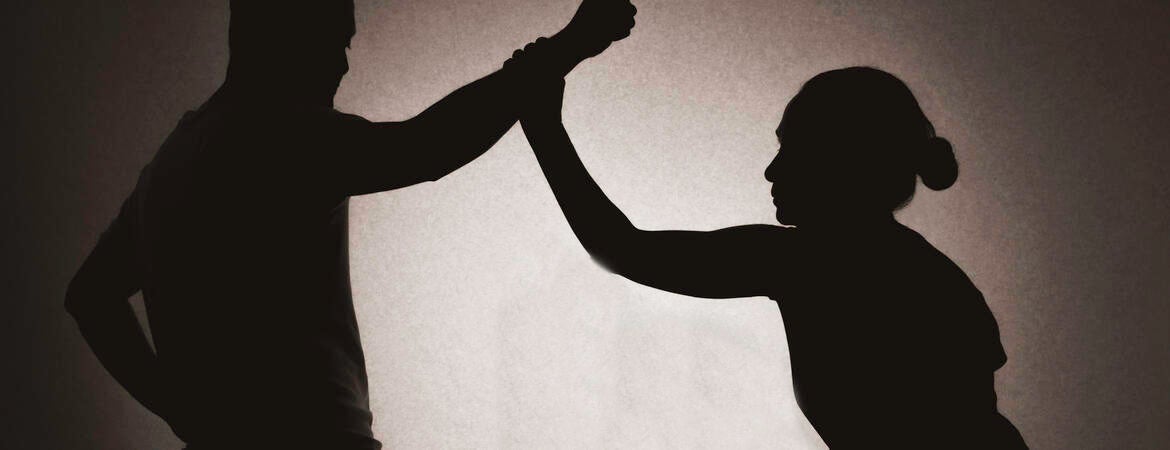
When Ms. A walked into the clinic something did not feel right. She was a woman in her early thirties. She was a very beautiful woman who was shining in her old ragged synthetic saree that must have originally been yellow but was now with a brownish tinge. Her steps were measured and slow, and there was a stoop in her posture. Her face was bereft of any emotions. Her eyes just showed a blank stare. I welcomed her and asked her to take her seat. I had a young family medicine post graduate student shadowing me in the clinic that day. She sat facing the young doctor and told her, “I have this pain and swelling” and showed her left arm. She pulled up the pallu of her saree and revealed the arm where she had the pain. There was a dark blue bruise with a painful looking swelling. The young doctor touched it and the lady winced in pain. Through this small interaction and the painful moment, there were no expressions on her face.
“Did you fall? Did you hurt yourself?”
“No”
“Did you hit your arm against a door or some hard object?”
“No”
“How did this injury happen? This looks like someone hit you or you hurt yourself by banging against some hard object.”
Throughout her responses were mono syllable or just nodding of the head. All along there was still no expression on her face. By now, I already started getting the clue that she must have been beaten up by her partner. I did not want to probe her any further with my questions. I stopped the young doctor from asking any further questions.
“I understand, we won’t ask you anything more. Do you have similar injuries anywhere else in your body?”
She stood up and pulled up her saree and revealed bruises on her thighs, knees and legs. The fact that she overcame her modesty and revealed her legs to a male doctor spoke volumes about how emotionless, numb and paralyzed with fear she must be. She was typically beaten black and blue.
“I will write a pain killer injection to help with the pain. I will also give you some medicines to handle the pain. Do you have ice cubes at home?”
“No”
“I will arrange for an ice pack. Please go to the treatment room and the sister will take care of you.”
I arranged for the staff nurse to give her the painkillers and icepack and ask her about her food.
I have often observed that survivors of domestic violence go through repeated episodes of such gruesome violence that mostly they are numb. They feel disembodied and often go about the treatments of their bodily injuries like some household appliance is broken down and is being repaired. When I started working at the Rural Women’s Social Education center almost 15 years ago, I encountered survivors of domestic violence for the first time. I had never seen women with serious injuries that resulted from being beaten up by their partners till then. But after joining the NGO, which works specifically for women’s health and wellness, I started seeing so many of them. One time it was a woman with a deep gash on her scalp. The husband brought her to the clinic. He appeared concerned. I had no clue that this was domestic violence. When we went to the treatment room where I started suturing the gash, the staff nurse told me that the guy sitting outside, anxiously, is the perpetrator of the violence and it was he who banged her head against the stone kept for washing clothes. I was 15 years younger than now and was furious. I wanted to report it to the police immediately. The sisters calmed me down and told me to watch as the counseling and social work processes started. The violence counselor would talk to the wife and provide full support if she wanted to leave the partner and go to a safe space. There were options for short stay homes where she and her children could be housed before legal action could be taken. Going to the police was always an option. But invariably none of the women, not even the one whose scalp was broken, not even the one whose saree was set on fire and part of her thighs underwent third degree burns, none of them pressed charges against their ‘loving husbands’ and always went back to live with them. I am not blaming them. It is extremely challenging to live as a single woman in a rural area. There are instances where their own fathers in law, brothers in law, uncles would make passes at them and force them against their will to engage in relations with them.
Domestic violence destroys the life of the survivor in so many ways. Firstly, the woman loses her ‘home’. Home is a safe sanctuary. When I am done in my clinic, I go home with the familiar feeling of comfort, getting off the work clothes, getting into comfortable home clothes, eating comfort food, relaxing in my chair and reading a book, or listening to music or watching something on TV. Home is safe; home is comfortable. But imagine home being the place of violence. Where does the woman go? It is paradoxical that the sanctuary that is home, becomes the threat. Secondly, her life becomes predictably unpredictable. She can be sure that any time anything can happen. Her partner could cuddle her one moment and beat her up the very next. The unpredictability shrinks all her possibilities. She must plan everything in her life such that she does not trigger a violent spell. She loses her spontaneity. Thirdly, she loses the sense of self. Being constantly gaslighted, isolated and violated, she starts losing her inner voice. The noise in her mind is so loud that it drowns the soft voice of the “I”. She no longer understands or knows who she is or what she wants. These are probably the reasons why Ms. A was having a blank affect.
Treating a woman with intimate partner violence is very hard. Treating the injuries and bodily trauma is the easier part. Fixing a fracture, suturing a laceration, painkiller injections for the injuries are the simpler treatments. The harder part is helping her heal her mind and self. The body repairs itself like magic. I have always wondered at the magic of the human body’s capacity to repair itself. Even broken bones that are not fixed heal, even gashes that are left unsutured heal. The biomedical healing is predictable, observable and organic. But when the ‘self’ is injured, the healing is not as easy. I have learned that we can do very small things in the clinical encounter to help the woman feel a semblance of normalcy and identify with her ‘self’. Explaining myself before examining her, taking permission before touching her, such small actions reinforce to her that she has autonomy over her body and she owns it. Respecting her choices to not be questioned, not be bothered by unnecessary advice or talks, gives her something that was stripped away from her, her agency. I have also observed that not judging her for choosing to go back to the abusive partner and being the patient listener who is available when she needs it, goes a long way in re-establishing her agency, her decision and her choices. The focus is not to fix all her problems for her, but to support her as she slowly and steadily heals her ‘self’ and regains her agency.
Comments
Post a Comment