Book Review: Sacred and cyclical: an extraordinary free verse on experiences and emotions of the menstrual cycle
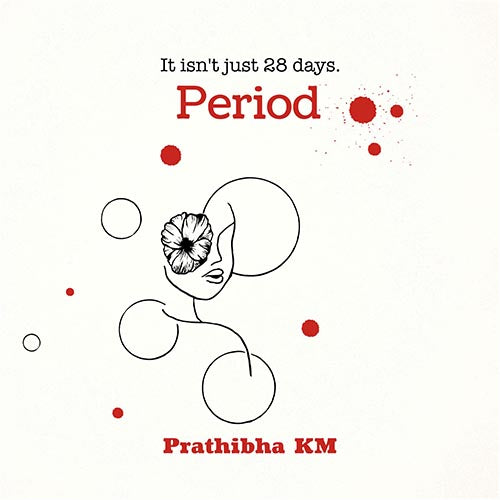
Book Title: “It isn’t just 28 days. Period”
Style: Free verse poetry
Author: Dr. Prathibha K M
Price: Rs. 229.00
Printed by: Periyar Books.com
Can be ordered at: https://periyarbooks.com/products/it-isnt-just-28-days-period?srsltid=AfmBOop6vovn8Ap5JJDejw1o5vi-RyAxfYH1eX68vIzqXiHx_HXEa0ci
A young girl accompanied by her mother, with a tear-streaked face, forehead fully creased with the wrinkles of pain, holding her lower abdomen and walking with a stooped posture into the clinic is something I see frequently. The staff of the clinic know even without asking that it is the painful cramps of ‘that time of the month’. Immediately they make her lie down in the bed, give her a hot water bag, and some warm water to drink. They would call me to go and check on her. I cannot assume all abdominal pain in a young woman to be menstrual cramps and so I would very politely and softly ask a few questions to rule out something else causing the pain. I am probably the last person she wants to see at that time. I can see, “What is he doing here? Doesn’t he know what this is? The nurse already said she knows and did all the right things. Why is he asking me so many questions? Why doesn’t he go away and just give me the pain killer shot? Why can’t I just go home?” I can see all these unasked questions flash through her face during the ultra-short interaction that I have with her. I scribble my notes in absolute awkwardness, and they give her the painkiller injection and, in a jiffy, she is gone. I have seen both mothers and daughters give me the look of derision, “What do you even know?” So, I respectfully keep my ministrations to the minimum and let the nurses handle the rest. I grew up with three women, mom and two sisters, but in orthodox households like ours, women don’t speak about menstruation in front of men, and God forbid, to men. All my understanding about menstruation has been purely physiological. I have marveled at the perfect rhythm in the cycle and been disturbed by the extent to which abnormalities in the cycle can lead to heavy physical, psychological, social disturbances in the woman’s life. I have developed a respectful approach to women with menstrual problems who come seeking my care. In fact, I have noticed that this respect has led to some women preferring to see me even on days when a skilled woman gynecologist is present in the clinic to see patients. Despite all these experiences, I have always known about menstruation and menstrual cycles from an outsider perspective, with a lot of uncertainty and reverent nescience.
My friend, a doctor, professor of Physiology and research collaborator Dr. Prathibha KM is an eloquent speaker and a good writer. She recently self-published her book titled “It isn’t just 28 days. Period” and it was released in the Mysuru Literary festival on 05 July 2026. The book contains free verses that capture the experiences, moods, state of mind, thoughts and perspectives of a woman through the 28 day menstrual cycle. I ordered my copy as soon as I knew about it and read it. This is a brief review of the book. I am a man, no uterus, no menstrual periods! Reading this free verse collection has deeply disturbed my status quo and provided me an intimate and intense insider perspective to the life a woman as she cycles through those 28 days. I am humbled and honored to write this review about the book.
Good literature is one that elicits a sense of empathy. Dr. Prathibha achieves something extraordinary in this free verse. She bridges her deep understanding of biology and physiology of the menstrual cycle with the emotions and lived experiences of going through them and provides an insider perspective with high educational value. There is a visual representation of the menstrual cycle in the form of a tabulation, a vestige of the scientist and teacher that she, which helps the reader appreciate the time periods of different phases. She places her chapter titles on the table like a table of contents that is presented as part of the cycle itself.
The free verse is full of symbolisms and metaphors. Four important symbolisms stuck with me for a long time after I finished reading the book. The verse opens with a heavy narration of the menstrual cramps and the pain associated with it. The first symbol is introduced here, the purple cushion! It is her silent, companion through the pain. It soothes her and helps her fight the cramps in silence. After an intense episode of crampy pains, she eases the “cramps” from the cushion. Note the play of words. Prathibha says “cramps” and not “crumples”. She transfers her physical sufferings into the purple cushion. What a brilliant linguistic touch!
She refers to day 4-6 of the period when there is heavy menstrual blood flow. The painful time is gone. This is a phase she calls Yen, an intense longing and desire. During this period, she says words flow off her pen. What a brilliant use of syllepsis! The flow applies literally to the menstrual blood and metaphorically to the creativity that flows out of her pen! It feels like the poem is literally flowing out of her body. The poet talks about Day 7 of the cycle when the bleeding is done, she refers to dark Kurtis. I have noticed the color choice of clothing that women make during menstrual cycles. It is a strong symbol of the inconvenience and restrictions that a woman must go through during periods. The dark Kurti manifests her inconvenience. She says from day 7 it is time for freedom of color choice! She mentions the blue flamingo as a symbol for the last few days of absolutely peace and quiet during the menstrual cycle just before premenstrual syndrome hits. Flamingos are usually flaming pink or orange in color. A blue flamingo does not exist in nature. But turning the flamingo blue is a symbolism for peace and quiet. It represents a rare and poised equilibrium state that presents on day 23-24 of the cycle. These literary devices make the free verse deeply personal and offer an intense emotional angle to it.
One more thing Dr. Prathibha succeeds in achieving is the capture of all the wide variety of emotions and experiences a woman goes through each month. Yesterday when I got the book, I was too excited and so read it quickly once. To be honest, my grasp of poetry is weak, and I take several readings to engage with it meaningfully. So, I read it again two more times all within a span of 2 hours. The first feeling I got after I read it was a vague disturbance. I could not understand why I was disturbed. I sat and reflected on it and discovered that I had read the poem too fast several times. The poem takes you through the excursions of a woman’s state of mind that happens in a month. I was internalizing these excursions rapidly in less than an hour. I was left with an overwhelming sense of awe at how much fluctuations of mood a woman routinely goes through. Despite this she remains fully functional, she shows up, she achieves often far more than what I can. I have always known about this as hearsay, but reading this free verse gave me an inner peep into what it feels like. I guess that is the power of literature! She has titled each phase beautifully as Cramped, Yen, Done, Sweet Nothings, Amorous, Sanguine, Buoyant, Sunny side up, Upbeat, Blue flamingo, PMS (bl)hues and so on. The transition from pain, to passion, desire, love, self-care, peace, tranquility, pre-menstrual anger, frustration, rage, and back to pain has been captured brilliantly.
To me Dr. Prathibha’s poetry peaked in the chapter titled Sanguine. She describes how her mind is free, cheerful, optimistic and looks at all the beautiful things in the world around her. She says something intensely philosophical,
“Isn’t everything that I think, write, feel, wish, have, want, a desire so transient? So what if it’s transient..as long as I can transcend..?”
This verse opens a small window into her mind and shows us what a deeply philosophical soul she is. Dr. Prathibha realizes her full potential as a woman in this chapter. She acknowledges that all her emotions and experiences including the pain, desire, longing, excitement, peace, anger, frustration, everything is transient. The cycling of everything in the month shows her this transient nature of everything. However, she doesn’t despair from this fleeting nature of her experiences, she emerges strong and says the power of having these fleeting experiences is that she knows she can transcend all this. She can transcend the pain, suffering, misery, anger, excitement, happiness, and still function as a daughter, mother, partner, doctor, professor, administrator, researcher and poet!
This free verse is an exquisite piece of art. It refuses to sanitize a woman’s bodily and psychological experiences and present a polished version to the world; It says it as it is. Dr. Prathibha demonstrates what is means to live in sync with one’s bodily experiences and emotions. I found the verse eye opening. I will now see menstrual cycle in a completely new dimension. I wish I had read this when I was a medical college teacher. I would have made this recommended reading in philosophy class on menstrual cycle. I would have recommended that all students rotating through obstetrics and gynecology must go through this. I see value in men reading this, because it gives a completely new understanding of the women in their lives. I see value in women reading this because they now get beautiful words, symbols and metaphors to decode what they experience every month.
Comments
Post a Comment